Key Takeaways
-
Uneven trails, loose rock, and downhill descents place repeated lateral stress on the ankle, especially as leg muscles tire over long distances.
-
The right ankle brace adds support and stability without restricting the range of motion hikers need on varied terrain.
-
Brace needs shift depending on the hike: day hikes call for lightweight support, while multi-day backpacking benefits from more structured compression.
The best ankle brace for hiking adds stability on unpredictable terrain without limiting the movement your ankle needs on the trail. Hikers face different demands than runners or team-sport athletes, since trail surfaces change constantly.
This guide covers how terrain, fatigue, and pack weight affect ankle stability, then compares braces and boots. It pairs well with our companion guide, Best Knee Brace for Hiking.
Why Uneven Terrain Increases Ankle Rolling Risk
Uneven terrain is one of the biggest contributors to ankle rolling on the trail. This means loose rock, roots, and scree force the ankle into constant micro adjustments, and each one is a chance for the joint to roll past its stable range.
A study of hikers in uniformed training groups found that most hiking-related ankle sprains were lateral and occurred most often on scree and downhill slopes. A broader systematic review of hiker injuries also identified ankle sprains among the most common trail injuries.
How Downhill Hiking Fatigue Affects Ankle Stability
Downhill sections demand more from ankle stabilizer muscles than climbing does. Unlike uphill hiking, where leg muscles mostly propel the body forward, downhill hiking asks the ankle to control descent and absorb impact with every step.
As those muscles fatigue over miles, the ankle relies more on ligaments alone, raising the risk toward the end of a hike. Copper Fit's sleeves and braces help support circulation and can ease muscle soreness that builds up over long descents, giving tired stabilizer muscles added support through the final stretch.
Does Pack Weight Change Your Ankle Support Needs?
Yes, pack weight changes the load your ankles absorb with every step. A study of long-distance hikers found that backpack loads above roughly 10 percent of body weight led to a measurable increase in plantar pressure through the feet.
Several factors compound this on the trail:
-
Total pack weight relative to body weight
-
How evenly the load is distributed between the hips and the shoulders
-
Trail incline and descent grade
-
Footwear stiffness and ankle support
Heavier loads and longer descents place demands on the lower body similar to the knee stress covered in our knee brace guide, so hikers managing both joints benefit from pairing supportive footwear with compression gear.
Ankle Brace vs. Hiking Boot: Do You Need Both?
Boots and braces serve different roles, and many hikers benefit from using both. Boots provide tread, structure, and weatherproofing, while a brace adds targeted, adjustable compression that a boot alone cannot offer.
|
Feature |
Hiking Boot |
Ankle Brace |
|
Primary role |
Traction, structure, protection |
Targeted compression, adjustable support |
|
Ankle mobility |
Often stiff or rigid |
Flexible, moves with the joint |
|
Best for |
Trail grip and terrain protection |
Added stability and recovery support |
Be cautious of relying on boots alone if you notice tension or soreness in your ankles after hikes. A review of postural control research found that both semi-rigid and soft ankle braces improved dynamic stability measures compared with no brace, supporting the case for pairing boots with a brace.
Day Hikes vs. Multi-Day Backpacking: Choosing the Right Brace
Shorter day hikes generally call for a lightweight sleeve or sock, while multi-day backpacking benefits from a brace with more structured, adjustable compression.
-
Day hikes: lightweight compression sleeves that move freely for a few hours on the trail
-
Multi-day backpacking: adjustable braces built for repeated daily wear and heavier pack loads
Copper Fit offers both, from everyday compression sleeves to more structured braces, so that hikers can match support to the trip ahead.
FAQ
Do I need an ankle brace for every hike?
Not necessarily, but a brace helps on uneven or unfamiliar terrain, especially for hikers prone to ankle tension after long days.
Can I wear an ankle brace with hiking boots?
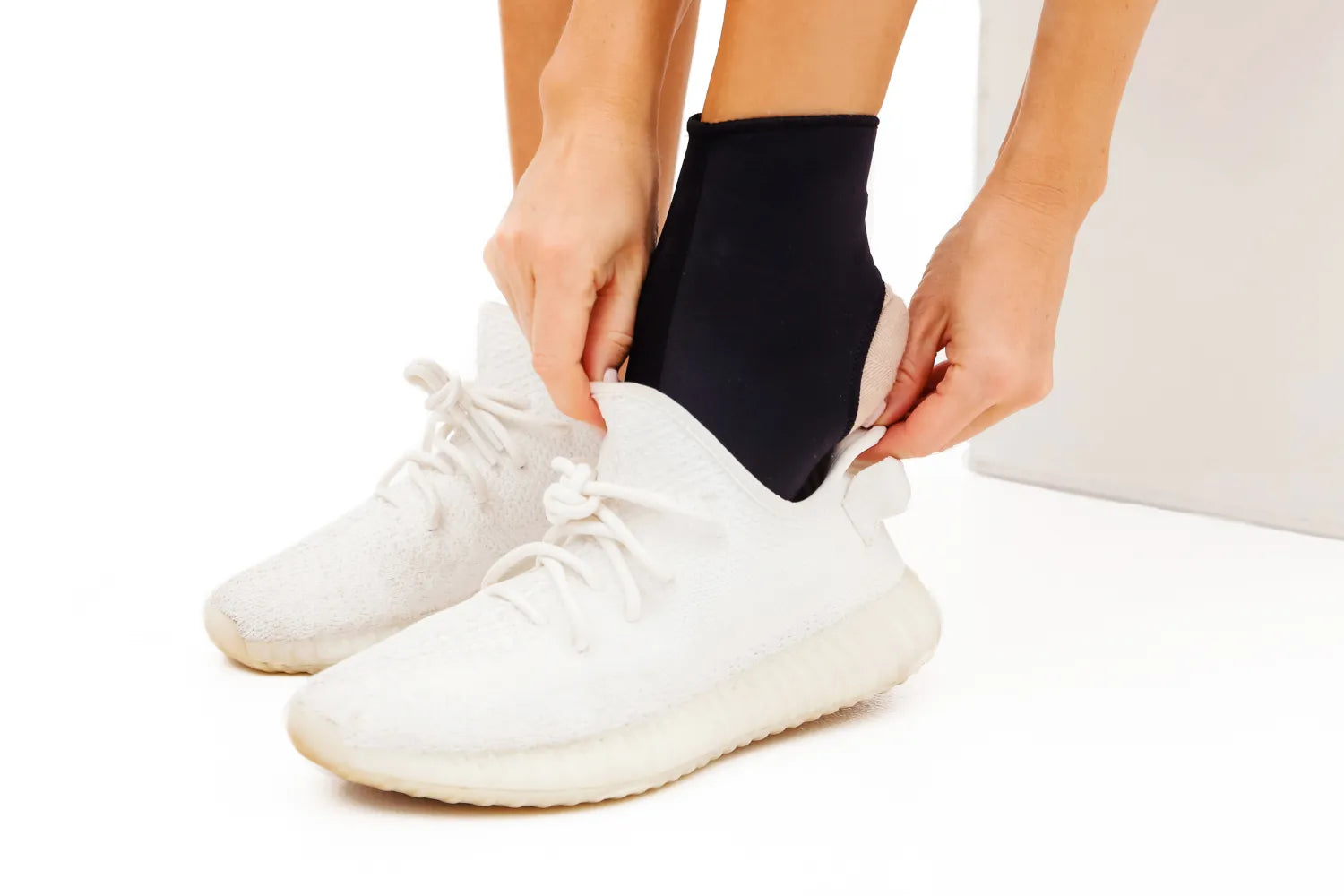
Yes, most sleeves and braces fit comfortably under a standard hiking boot without added bulk.
How tight should a hiking ankle brace fit?
Snug and supportive, without restricting circulation or limiting the natural range of motion.
Are ankle braces only useful after an injury?
No, many hikers wear them proactively to help support stability and ease soreness on long or technical trails.
Sources:
The Epidemiology of Ankle Sprain During Hiking in Uniformed Groups | ScienceDirect