Key Takeaways
-
Flat feet often lead to overpronation, which can create tension that travels up into the knees, hips, and lower back.
-
The best insoles for flat feet depend on your activity level: rigid support is suited for stability, while cushioned support is suited for shock absorption.
-
Copper Fit's Arch Relief Plus offers adjustable, targeted support that pairs well with the right insole for a more complete approach to arch support.
Flat feet are one of the most common foot types out there, but they tend to go unaddressed until tension starts showing up somewhere else in the body. If you have ever dealt with soreness in your feet, knees, or lower back after a long day on your feet or a tough workout, your arch support, or lack of it, could be part of the picture.
In this guide, we will break down what flat feet actually do to the rest of the body, the difference between rigid and cushioned arch support, how to choose the right insole based on your activity level, and a few Copper Fit picks worth considering.
If you are on the opposite end of the spectrum with high arches, our companion guide on insoles for high arches covers that.
What Flat Feet Do to the Body
Flat feet mean the arch of the foot sits low or makes full contact with the ground instead of curving upward through the middle. That structural difference changes how the foot handles impact and often sets off a chain reaction that extends well beyond the foot itself.
Overpronation
When the foot is flat, it tends to roll inward more than it should with each step, a movement pattern known as overpronation. Instead of rolling inward briefly to absorb shock and then stabilizing, an overpronated foot keeps rolling, changing how weight and force are transmitted through the rest of the leg.
The knock-on effect up the chain
Overpronation does not stay contained to the foot. Research on foot mechanics has found that excessive pronation during walking and running is associated with increased internal rotation of the shin, increased internal rotation of the hip, and shifts in pelvic tilt, all of which can further alter alignment through the lumbar spine.
A separate study using 3D motion analysis found that increased foot eversion led to measurable changes in lumbar and thoracic spinal curvature, showing just how directly foot alignment can influence posture higher up the body.
Why this matters for how you feel day-to-day
This is why someone with flat feet might notice tension not just in their arches, but in their knees, hips, or lower back after standing, walking, or training for extended periods. The chain reaction from foot to leg to spine means that supporting the arch is not just about the foot itself; it is about supporting the entire kinetic chain.
Beyond alignment, overpronation also changes how weight is distributed across the foot itself. Instead of pressure moving evenly from heel to forefoot with each step, an overpronated foot tends to load more heavily along the inner edge, which can leave that area doing more work than it is built to handle over the course of a day.
Research on flat feet and lower-limb coordination has linked excessive rearfoot motion to increased strain on connective tissue in the foot and greater stress on the knee joint during activity.
A large-scale review pooling data from multiple studies also found a consistent association between flat feet, a decreased arch, and lower back discomfort, reinforcing that foot alignment is not an isolated issue but part of a much larger picture.
None of this means flat feet are something to fear. It simply means the foot's structure has a real, measurable influence on everything built on top of it, which is exactly why the right support matters. Supporting the arch properly is one practical way to help ease that chain reaction before it builds.
Do You Have Flat Feet? Try the Wet Footprint Test
One of the simplest ways to get a general sense of your arch type is the wet footprint test. Wet the sole of your foot, then step onto a surface where the print will show clearly, like a dry sidewalk or a piece of paper on a hard floor.
If your footprint shows most or all of the sole with little to no curve along the inside edge, it typically indicates a flatter arch. A more defined curve with less contact through the middle usually means a neutral or higher arch.
This is a helpful starting point for understanding your foot type, not a diagnostic tool, so if you have ongoing concerns about your feet, a podiatrist can give you a more complete picture.
Arch Support Types: Rigid vs. Cushioned
Once you know you are dealing with flat feet, the next decision is what kind of arch support actually fits your needs. Insoles generally fall into two categories, and each serves a different purpose.
Rigid support
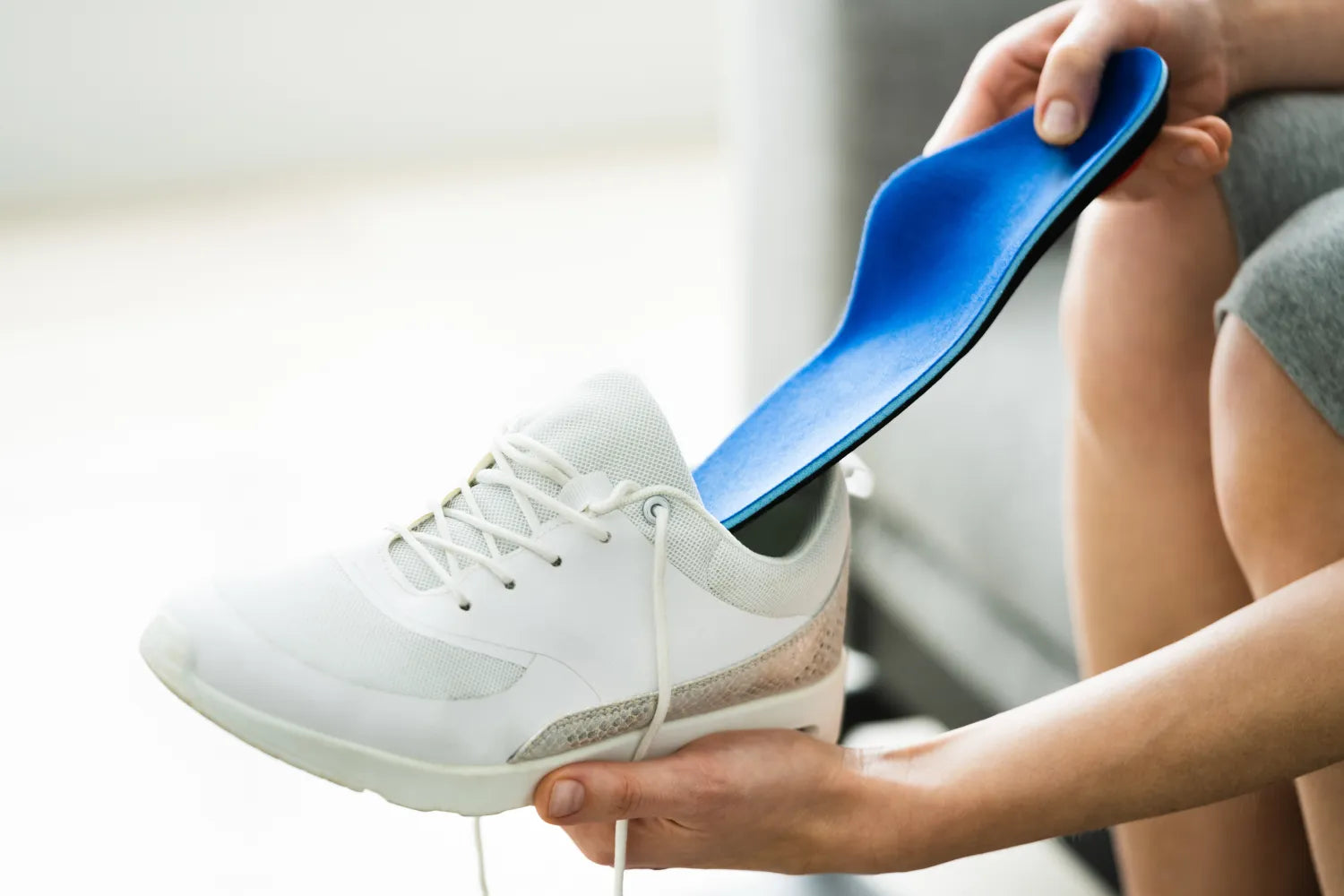
Rigid insoles are built for stability and motion control. They are firmer and designed to help limit how far the foot rolls inward.
This makes them a common choice for higher-impact activities or situations where control matters more than plush cushioning, like all-day standing jobs or structured workouts. The tradeoff is that rigid insoles offer less shock absorption than softer options.
Cushioned support
Cushioned insoles prioritize shock absorption and comfort. They use softer materials that compress and flex with the foot, which makes them a better fit for lower-impact daily use or for anyone who wants more give underfoot.
Research comparing insole materials has found that softer, higher-density materials are more effective at reducing peak plantar pressure than stiffer materials, because they absorb and disperse impact rather than transferring it directly through the foot. The tradeoff here is that very soft materials offer less structural correction for overpronation.
Finding the right balance
Some insoles are designed to blend both, offering a firmer base through the arch with softer cushioning at the heel and forefoot.
Studies suggest that anti-pronation insoles can, with consistent use over time, improve how the ankle , knee, and hip coordinate during walking, indicating real benefits from wearing supportive insoles consistently rather than only occasionally.
How To Pick by Activity Level
The right insole often comes down to what you are actually doing in it day-to-day.
Every day wear and standing jobs. If you are on your feet for long stretches at work or around the house, prioritize cushioned comfort that can handle hours of wear without breaking down. Look for insoles rated for all-day use, since some cushioned options are built more for short bursts of activity than sustained standing.
Walking and running. Look for a blend of support and shock absorption, especially through the heel and forefoot, where impact is concentrated with every stride. A moderate level of arch support paired with responsive cushioning tends to work best here, since too rigid a build can feel harsh over longer distances, while too soft a build can lose its shape before the end of a run.
Weightlifting and gym use. A firmer, more stable base helps support proper form during heavy lifts like squats and deadlifts, where a foot that rolls inward under load can throw off your entire stance. Stability matters more than plush cushioning in this setting, since a solid base of support helps you drive force evenly through the whole foot instead of losing power through an unstorch.
Sports and quick lateral movement. Activities that involve cutting, pivoting, or quick changes in direction place additional demands on arch stability. A supportive insole with a snug heel cup can help keep the foot centered during fast movements, improving balance and control.
Starting a new fitness routine. If you are just getting into a more active routine, the right insole can help you avoid some of the common discomfort that comes with doing too much too soon. Supporting your foundation early on makes it easier to stay consistent instead of getting sidelined by soreness in the first few weeks. This is especially true if you are increasing your activity level quickly, since your feet and lower body need time to adapt to new demands.
Top Picks for Flat Feet
For flat feet specifically, the Arch Relief Plus is built to provide adjustable, targeted support right where overpronation puts the most strain. Its compression design supports the arch and soothes tension that builds up after a long day on your feet or a demanding workout.
It is not a replacement for a good insole, but it works well alongside one, giving you a more complete, layered approach to support instead of relying on a single product to do everything.
Along with a support band like the Arch Relief Plus, pay attention to a few core features when choosing an insole: contoured arch support that matches your foot's shape, a stable heel cup, moisture-wicking material for all-day wear, and copper-infused fabric, which is well known for helping reduce odor during heavy or extended use.
How to layer for a complete approach
Many people find that pairing a supportive insole with an arch band like the Arch Relief Plus gives them more consistent support throughout the day, especially on days with a lot of walking, standing, or training. Think of the insole as your foundation and the band as extra, targeted reinforcement when you need it most.
When to replace your insoles
Cushioning and support break down with regular use, even on high-quality insoles. A general guideline is to reassess your insoles every six to twelve months, or sooner if you notice the material has flattened out or no longer feels supportive underfoot. Insoles that have lost their structure will not offer the same benefit, even if they still look fine on the surface.
FAQ
How do I know if I have flat feet?
The wet footprint test is a simple way to check. Wet your foot, step onto a surface that will show the print clearly, and look for little to no curve along the inside edge of the footprint.
Can insoles help with flat feet?
Yes. The right insole supports the arch and distributes pressure more evenly, which can help ease tension that travels up through the knees, hips, and lower back.
Should I get rigid or cushioned insoles?
It depends on your activity level. Rigid insoles are better for stability during high-impact activities or all-day standing, while cushioned insoles are better for comfort during low-impact daily use.
Can I use an arch support band with insoles?
Yes. A band like the Arch Relief Plus can be layered with insoles to provide extra, targeted support on top of your everyday foundation.
The Bottom Line
At Copper Fit, we know flat feet can create tension that shows up in places you might not expect, from your knees all the way up to your lower back. That is exactly why we build our support gear, including the Arch Relief Plus, to work with your foot's natural movement.
Whether you are on your feet all day, training for something bigger, or just starting to build a more active routine, our compression and support gear is designed to help you move through your day with less tension and more confidence, every day.
Sources:
Flatfeet - Symptoms and causes | Mayo Clinic
Overpronation: What It Is, Causes & Treatment | Cleveland Clinic