Key Takeaways
-
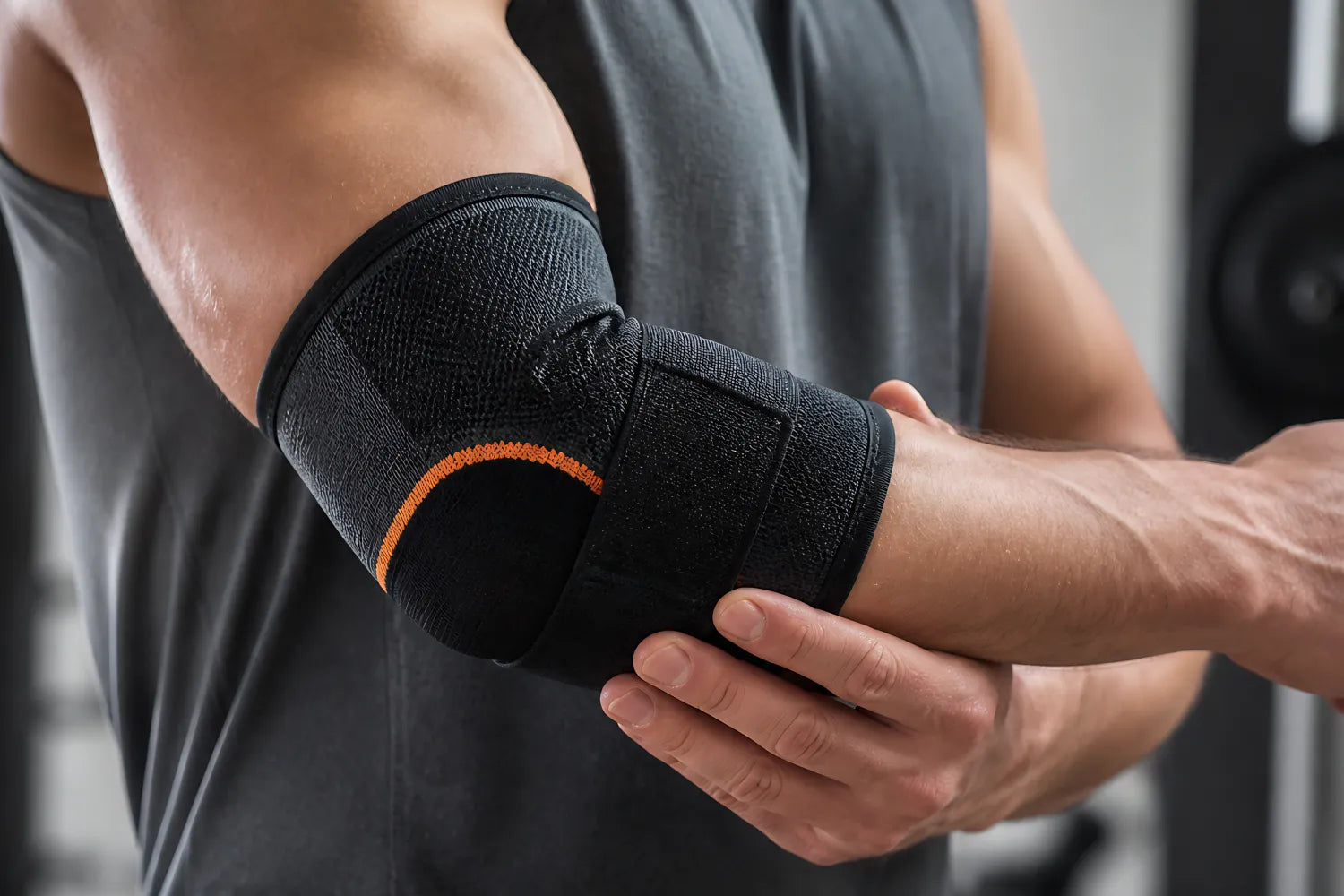
An elbow sleeve supports the joint under load through warmth, compression, stability, and proprioceptive feedback.
-
Sleeve thickness should match your training style, with lighter options for mobility work and thicker options for max-effort lifts.
-
Elbow injuries are among the most common in powerlifting, making joint support a smart addition to a heavy training program.
If you lift heavy, your elbows take on repetitive stress with every press and pull. As training volume or load increases, many lifters look for ways to help the joint feel more stable and supported throughout a session.
Choosing the best elbow brace for lifting comes down to two things: understanding how a sleeve actually helps under load, and matching sleeve thickness to the way you train.
How Does an Elbow Sleeve Help Under Heavy Load?
An elbow sleeve supports the joint through three main mechanisms: warmth, stability, and proprioception.
-
Warmth: A snug sleeve helps keep the joint and surrounding tissue warm, which may help ease tension during warmups and heavy sets
-
Stability:Compression helps support the joint as it moves through a fixed pressing or pulling path
-
Proprioception:Research shows that compression garments can improve joint position sense, meaning the body may have a better sense of where the joint is in space during a lift
A systematic review and meta-analysis published in the Annals of the New York Academy of Sciences found that wearing compression garments reduced errors in joint position sensing compared with not wearing them, suggesting that the added input from compression may help sharpen a lifter's awareness of joint position under load.
Elbow support is also worth prioritizing because the joint is often involved in lifting-related strain. A retrospective study of competitive Oceania power lifters found that the elbow accounted for 11% of all reported injuries, behind only the shoulder and lower back.
A 2024 systematic review in BMJ Open Sport and Exercise Medicine similarly found the elbow and upper arm to be among the most commonly affected sites in powerlifting.
How Thick Should Your Elbow Sleeve Be?
Sleeve thickness should match your training style.
-
A lighter sleeve prioritizes flexibility and works well for mobility work or overhead pressing, where range of motion matters most.
-
A medium sleeve is suitable for general training days.
-
A thicker, more structured sleeve is built for heavy bench or pulling days, when the joint is under the most direct load.
Quick Comparison Table
|
Sleeve Type |
Compression Level |
Best For |
|
Light |
Mild |
Mobility work, overhead pressing |
|
Medium |
Moderate |
General training, everyday wear |
|
Thick |
Strong |
Heavy bench or pulling days |
Unlike a thin sleeve worn mostly for warmth, a thicker sleeve is designed to support the joint through the added strain of near-maximal loads.
Best Elbow Sleeves by Lift Style
Different lifts place different demands on the elbow, so the right sleeve depends on what you're training that day.
The Ice Compression Elbow Sleeve is best for overhead pressing and high-rep work. It offers Maximum Support Compression with a seamless, anti-chafing knit and a menthol-infused cooling sensation, useful for lifters who want support without extra bulk restricting overhead range of motion.
Our Pro Series Compression Elbow Sleeve is best for pulling movements like rows, pull-ups, and deadlifts. The built-in kinesiology bands provide targeted, dynamic compression that moves with the joint through a pulling range of motion.
The Elite Elbow Sleeve is best for heavy bench and max-effort pressing days. Its medium-to-strong compression provides more structured support for lifters loading up for their heaviest sets.
For instance, a lifter alternating between bench day and pulling day might keep two sleeve types in rotation rather than relying on just one.
FAQ
Do elbow sleeves actually help with lifting performance?
Research suggests compression may improve joint position sense, but a sleeve is not a substitute for proper form and progressive loading.
Should I wear an elbow sleeve for every lift?
Not necessarily. Many lifters reserve sleeves for their heaviest pressing or pulling days, or for warmups when the joint feels stiff.
What's the difference between a light and heavy compression sleeve?
Lighter sleeves prioritize mobility and warmth, while heavier compression sleeves prioritize joint stability under maximal load.
Can I wear a Copper Fit elbow sleeve all day, not just during lifts?
Yes. Sleeves like the Pro Series are designed for all-day wear to help support recovery between training sessions.
Sources:
Influence of compression garments on proprioception: A systematic review and meta-analysis | PubMed
Injuries in weightlifting and powerlifting: an updated systematic review | PubMed