Key Takeaways
- A hyperextended knee happens when the knee is forced backward past its normal range, stretching or tearing the ligaments that hold it in place.
- Mild cases typically heal within two to four weeks with proper rest, compression, and bracing, while more severe injuries involving ligament damage can take three to nine months.
- Supporting recovery with the right compression, cold and heat therapy, and progressive movement can make a real difference in how quickly you get back to doing what you love.
A hyperextended knee occurs when the knee bends backward beyond its normal range, stretching or tearing the ligaments. Mild cases heal in two to four weeks with rest, ice, compression, and bracing. Severe hyperextension injuries involving ACL or PCL damage may take three to six months.
The good news? Most hyperextended knees heal well. And with the right approach, you can support your recovery every step of the way.
What Is a Hyperextended Knee?
Your knee is built to bend in one direction, but a hyperextended knee happens when it straightens past its neutral position and bends the other way. Even a few degrees beyond your knee's normal range is enough to put significant stress on the surrounding ligaments, tendons, and cartilage.
This injury is common in high-impact sports like football, basketball, and soccer, where sudden stops, collisions, and awkward landings put the knee in vulnerable positions. It can also happen in everyday situations: a misstep off a curb, a fall on an uneven surface, or even overextending during a workout.
The severity can vary. A mild hyperextension is an overstretch in which the ligaments are stressed but remain intact. A severe hyperextension can involve partial or complete tears of major ligaments, most commonly the ACL (anterior cruciate ligament) or PCL (posterior cruciate ligament).
Understanding where you fall on that spectrum is the first step toward smart recovery.
What Are the Symptoms of a Hyperextended Knee?
How your knee feels immediately after the injury can tell you a lot. Here are the most common symptoms to watch for:
- Sharp discomfort at the back of the knee is often the first and most immediate sign
- Swelling can develop within minutes or over the first few hours
- Instability is a sensation that the knee is giving way or might buckle under your weight
- Limited range of motion involves difficulty fully bending or straightening the leg
- Bruising” may appear around the knee within 24 to 48 hours
- A popping sensation is a sign that you may have a more severe injury
A popping sound or feeling at the moment of injury often signals a ligament tear — most commonly the ACL or PCL. If you experienced a pop, it's worth getting evaluated by a medical professional as soon as possible to best support your recovery.
How Long Does a Hyperextended Knee Take To Heal?
Healing time depends heavily on the severity of the injury. Here's a general timeline to help you understand what to expect:
Mild Hyperextension (Grade I): 2 to 4 weeks
Ligaments are overstretched but not torn. Most people can return to light activity within a few weeks with proper rest, compression, and gradual movement.
Moderate Hyperextension (Grade II): 4 to 8 weeks
There is a partial ligament tear involved. Recovery requires more structured rest, physical therapy, and consistent bracing. Returning to high-impact activity too soon can extend recovery or lead to reinjury.
Severe Hyperextension (Grade III): 3 to 9 months
A complete ligament tear is present, often requiring surgical intervention followed by a structured rehabilitation program. Full recovery at this level takes patience and professional guidance.
The severity of the initial injury matters most, but age, prior injury history, and how consistently you follow your recovery plan can all influence where you fall within these ranges.
How To Support Hyperextended Knee Recovery
What you do in those early days and weeks can make a real difference in your recovery timeline.
Here are some tips to support your recovery through each stage.
Early Phase: Days 0 to 7
This is the most important window for protecting the joint and managing soreness. During these early days, follow the RICE method .
Focus on:
- Rest: Avoid putting unnecessary load on the knee. Use crutches if weight-bearing feels unstable or especially uncomfortable.
- Ice: Apply cold therapy for 15 to 20 minutes every two to three hours for the first 48 to 72 hours. Our Copper Fit Rapid Relief Knee Wrap delivers targeted cold therapy right where you need it, and can also be used as a heat wrap once you move past the acute phase.
- Compression: A well-fitting compression sleeve can help support the joint, promote circulation, and encourage recovery .
- Elevation: Keep the knee elevated above heart level when resting to help manage swelling.
Mid Recovery: Weeks 1 to 4
As acute soreness and swelling start to subside, it's time to reintroduce gentle movement. Work with your healthcare provider or physical therapist to begin range-of-motion exercises and progressive weight-bearing.
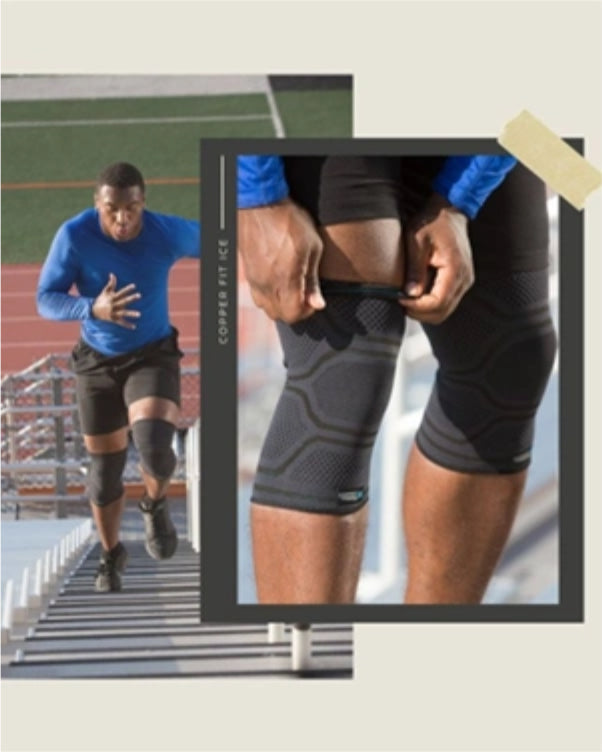
Continue wearing your compression sleeve during activity and PT, as consistent compression supports healthy blood flow and helps soothe residual tension as the tissue heals. At Copper Fit, our compression sleeves feature copper-infused, 4-way stretch fabric with a contoured fit that's breathable enough for all-day wear.
Return to Activity
When returning to more consistent activity, don't rush this process. Start with low-impact activity and gradually build intensity over several weeks. Wearing a supportive brace or sleeve during the transition back to sport helps protect the knee and gives you the confidence to push forward without second-guessing every step.
When To See a Doctor
While most mild hyperextensions can be managed at home with RICE and appropriate compression, certain signs mean you should get a professional evaluation right away.
See a doctor if you experience:
- Inability to bear weight on the injured leg
- An audible or felt pop at the time of injury
- Severe or rapidly worsening swelling
- Knee instability, or a feeling that the joint cannot support you
- Discomfort that persists for more than two weeks without improvement
A popping sensation or persistent instability are strong indicators of ligament involvement, which requires MRI imaging to fully assess the damage. Don't wait for these symptoms. Getting an accurate diagnosis early means a smarter, faster recovery.
Stretches and Exercises To Strengthen the Knee
After the first week of focusing on the RICE method, incorporating progressive strengthening exercises can help rebuild strength and stability around the knee joint. Consistency matters more than intensity here. A focused 10-minute daily session will do more for your recovery than sporadic hour-long workouts.
Here are four progressive exercises to add to your daily recovery routine:
1. Quad Sets Sit or lie flat with your leg extended. Tighten your quadriceps by pressing the back of your knee toward the floor, hold for 5 seconds, then release. Start with 2 sets of 10 to 15 reps.
2. Straight-Leg Raises Lie on your back with one knee bent and the other straight. Tighten your quad, then lift the straight leg to about 45 degrees. Lower slowly. Perform 2 to 3 sets of 10 to 12 reps.
3. Hamstring Curls Stand and hold a chair for balance. Slowly bend one knee, bringing your heel toward your glutes, then lower back down with control. Complete 2 to 3 sets of 10 to 12 reps on each leg.
4. Wall Sits Stand with your back flat against a wall and slide down until your knees are at roughly a 90-degree angle (or as far as comfortable). Hold for 20 to 30 seconds and build from there. Aim for 2 to 3 rounds.
Remember, these exercises are designed to be progressive. Start at the easier end and build over time. If any movement causes a significant increase in discomfort, back off and consult your physical therapist before continuing.
FAQ
How do you know if you hyperextended your knee?
The most common signs are immediate discomfort at the back of the knee, swelling, a feeling of instability, and limited range of motion following a fall, collision, or awkward landing. A popping sensation at the time of injury is a particularly important signal and warrants prompt medical evaluation.
How long does it take a hyperextended knee to heal?
Mild cases generally resolve in two to four weeks with rest, ice, compression, and bracing. Moderate injuries may take four to eight weeks. Severe hyperextensions involving ACL or PCL tears can require three to nine months of recovery and may involve surgery.
Should I walk on a hyperextended knee?
For mild hyperextensions, light walking may be tolerable once the initial soreness subsides. However, if bearing weight causes significant discomfort, instability, or worsening swelling, avoid walking without support and consult a healthcare provider. Pushing through too soon can extend your recovery.
Sources:
Hyperextended Knee: Symptoms, Causes & Treatment | Cleveland Clinic
Anterior Cruciate Ligament Knee Injury | NIH
RICE (rest, ice, compression, and elevation) | UK Healthcare